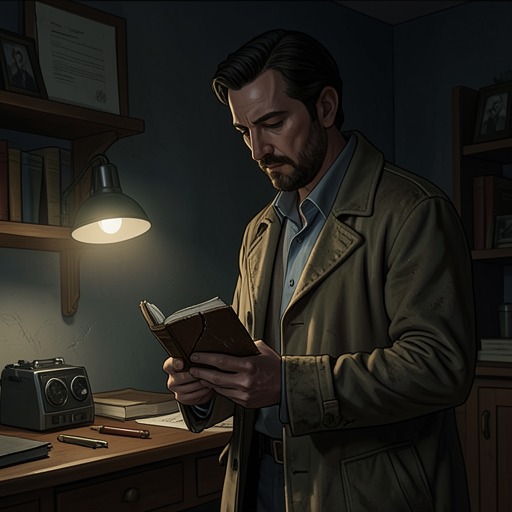
Franz Biberkopf’s one-armed condition
Berlin AlexanderplatzFranz Biberkopf’s one-armed condition begins with the attack that leaves him unconscious and results in the amputation of his right arm at the shoulder. It changes how he moves through the world, but the novel does not confine its meaning to bodily loss: the missing arm becomes part of his public identity, his efforts at independence, and the altered terms on which he returns to Berlin.
The Injury and Its Immediate Consequences
On the night of the attack, Franz is taken in a private automobile to Magdeburg. At the hospital, surgeons amputate his right arm at the shoulder joint and treat the damage to his shoulder bones. The narrative gives this change a precise physical and medical context, while withholding certainty about whether he has other internal injuries. His condition is serious enough that he remains in hospital, but the immediate account also follows what he can still decide for himself.
While lying injured on the road, Franz becomes acutely attentive to the people handling him. When they propose taking him to a hospital in Pankow, he refuses and supplies another destination: the home of Herbert Wischow on Elsasser Strasse. Herbert and Eva arrange for him to be cared for in the back of a pub, obtain a doctor, and secure fresh clothes before driving him out of Berlin. The choice of address and the insistence on where he will be taken show that even at his most vulnerable, Franz is trying to direct his own fate.
The account distinguishes physical recovery from emotional recovery. In hospital Franz initially holds himself still and gives little thought to the past. When Eva visits with tulips, he breaks down and cannot stop sobbing; the nurse worries that the visit is exhausting him. The next day he is calm and greets Eva with a smile. After a fortnight, he is collected and brought back to Berlin. The arm is gone, but the narrative marks a change in his response: seeing the houses on Elsasser Strasse stirs him without provoking the same collapse.
Returning to Berlin in a Changed Body
Franz’s return is framed as another attempt to enter the city and make a life there. He is carried from the car into Herbert’s flat, then later lies unconscious for an extended period as the weather turns warm. In that state, he recognizes that he may be close to death and fears that remaining in bed will finish him. He raises his one remaining arm and resolves not to stay there. When he finally goes back out, he is unsteady but able to walk.
The contrast with his earlier arrival after Tegel Prison is telling. Then, crowded streets, shop windows, and the moving mass of people overwhelmed him; ordinary urban life seemed strangely unreal and threatening. On his third return, he again faces Berlin with a changed body, but the account stresses his willingness to venture into the city despite his weakness. His remaining arm is not presented as a cure or as proof that his difficulties have ended. It is the arm he raises in defiance of death and the one with which he must continue to act.
The narrative’s montage places this bodily vulnerability beside the pile driver at Alexanderplatz. The machine repeatedly drives a pile into the ground, reducing it under a force it cannot resist. The image echoes the novel’s recurring language of blows and impact, but it does not simply explain Franz’s disability: the account of his arm remains a concrete consequence of violence, while the construction scene gives that violence a wider, impersonal rhythm in the city.
Disability, Clothing, and Public Identity
By June, Franz has assembled a polished public appearance. He buys an impeccable summer suit for twenty marks in cash and wears the Iron Cross on its left side for special occasions. The medal acts as a credential for his missing arm: passers-by show him respect, while proletarian observers respond with anger. The same visible sign thus brings him recognition and resentment, making his altered body part of how strangers interpret him.
His outfit also presents a marked contrast with his injured, dependent state. He now looks like a prosperous publican or master butcher, with carefully creased trousers, gloves, and a bowler hat. This composed appearance does not undo the amputation. Instead, it allows him to manage what others see: the missing arm is made legible through the medal, while the rest of his dress projects solidity and respectability.
Franz also carries forged identification papers in the name of Franz Räcker, a man killed during the 1922 troubles. He has memorized the details in those papers, including family and employment information, so he can answer a police officer’s questions. The prosthesis of identity here is not a physical replacement but a rehearsed documentary persona. Beside the Iron Cross, the papers show another way he adapts to exposure and scrutiny: he equips himself to appear prepared, even as his position remains precarious.
Independence and the Third Conquest
Herbert and Eva leave money for Franz, but he takes only a few pence and decides he must become independent. He applies for unemployment benefit and is told that inquiries must be made first, while payment will not be immediate. The exchange makes the practical limits of his resolve visible: he wants to support himself, yet his immediate needs cannot wait for an administrative process. His one-armed condition exists within these material pressures, not apart from them.
The novel calls this return Franz’s third conquest of Berlin. The first brought terror at the city; the second followed Lüders’s betrayal and ended in heavy drinking; now he returns after losing his arm and nevertheless enters the streets again. The language of conquest is deliberately in tension with the evidence of vulnerability: he is described as unsteady, and he must rebuild a life after hospital, dependence, and physical loss. His condition is therefore neither erased by his determination nor allowed to stand for the whole of his character. It remains a lasting fact of his body, a public sign others respond to, and a changed circumstance against which his attempt at independence takes shape.